
Adaptive Engineering is how Quest Defense Systems & Solutions delivers outcomes in complex, mission-critical environments.
We apply leading-edge technology and process innovation to create engineering lifecycles that are efficient, resilient, and continuous so progress doesn’t stall when requirements change, tools evolve, or teams shift.
This isn’t a methodology layered on top of work. It is the way we work.
The Reality
Engineering isn’t failing because of talent. It’s failing because of misalignment. Across Aerospace and Defense, programs face mounting complexity:- Requirements live in one place
- Safety artifacts in another
- Verification evidence somewhere else
- Critical knowledge trapped in individuals
What Is Adaptive Engineering?
A smarter way to design, deliver, and sustain complex systems. Adaptive Engineering applies leading-edge technology and process innovation to make the engineering lifecycle more efficient, resilient, and continuous.
Efficient
- Faster time-to-value without sacrificing rigor.
- Reduces redundancy, accelerates feedback, and enables reuse.

Resilient
- Absorbs change without breaking delivery.
- Preserves knowledge through turnover, tool changes, and shifting requirements.

Continuous
- Progress never resets.
- Learning, traceability, and verification evolve alongside the system.
Our Special Sauce: How We Work
Adaptive Engineering is polymath thinking at scale. QDSS brings together specialists across systems, software, hardware, safety, and operations as a connected delivery ecosystem. We don’t optimize parts. We optimize the whole. Adaptive Engineering emphasizes:- Early cross-disciplinary integration
- Systems-first decision making
- Continuous feedback loops
- Context-aware rigor
- Knowledge embedded in platforms, not people
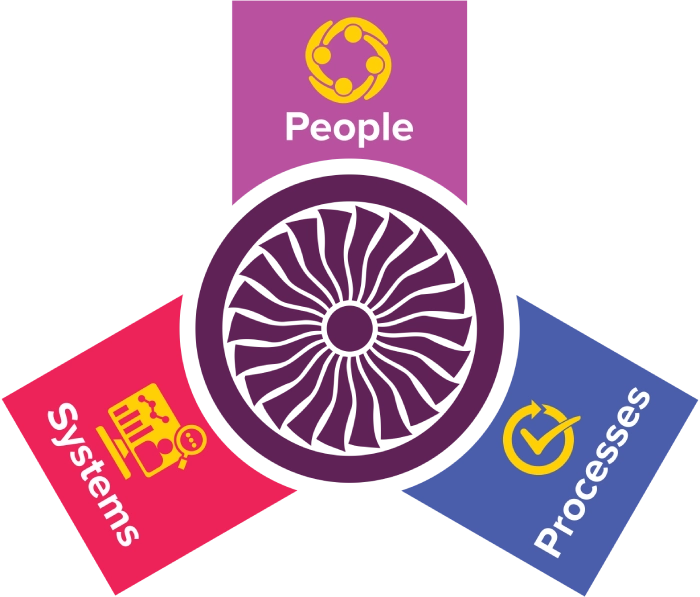
The Adaptive Engineering Framework
Turning theory into execution.
Every QDSS engagement maps to five efficiency domains that guide delivery across the full lifecycle.
Traceability Acceleration
Embedding requirements, design, and test linkages directly into engineering workflows.
Knowledge Continuity
Capturing engineering rationale so expertise survives personnel and program changes.
Adaptive Process Scaling
Right-sized rigor based on program phase, risk, and customer context.
Automation & Reuse
Templates, models, regression suites, and repeatable pipelines that eliminate redundant work.
Validation & Lifecycle Optimization
Detecting issues earlier and streamlining certification-ready evidence.
Adaptive Engineering in Action
What Changes for Customers
From document-driven to system-driven engineering.
Outcome Tiles
- Faster certification readiness
- Reduced late-stage compliance risk
- Preserved program knowledge
- Accelerated verification
- Higher confidence confirmation
Instead of managing artifacts, teams manage intent.
Instead of reacting late, risks surface early.
Instead of rebuilding knowledge, it’s continuously reused.
Low-Risk Adoption
Practical. Incremental. Safe.
Adaptive Engineering meets customers where they are.
We integrate with existing workflows, scale alongside program maturity, and preserve regulatory rigor without forcing disruptive transformation.
Progress is deliberate, not disruptive.






 Chris Hardgrave joined Quest Defense in April 2024 as Vice President for Strategic Accounts. He is responsible for sales, growth, and development of strategic relationships for new business development efforts in the Aerospace and Defense sector. Chris works in the Washington, D.C. office.

 As Chief Engineer for Quest Defense, Jon is responsible for ensuring that sound engineering processes are maintained and followed by our employees working in a diverse set of services and disciplines across all verticals. In this role he also leads Quest Defense’s efforts to develop new methods and technologies to help grow the business through innovation, as well as building and promoting the technical reputation of the company in the public sphere.
 Jeff Fischer serves as a board member for Quest Defense Systems and Solutions business. Additionally Jeff is the Operations Leader for the Quest Global Aerospace and Defense Industry.

 Steve Gerber is President and CEO of QuEST Defense Systems and Solutions business and is responsible for providing the leadership and growth of this venture.
 Joe supports Special Missions across Quest Global to include key client contract negotiations, strategic business solutions, M&A, and culture endeavors.
 Frank Kendall is an independent consultant to defense industry firms and non profit research organizations. He is a Senior Fellow at the Center for American Progress, a Senior Advisor to the Center for Strategic and International Studies, and a member of th e Council on Foreign Relations. Among other industry positions, he is a member of the board of directors of Leidos Corporation and of Leonardo Electronics USA Inc. From 2012 to 2017, Mr. Kendall served as the Under Secretary of Defense for Acquisition, T echnology and Logistics (AT& after serving as the Principal Deputy Under Secretary from 2010 2012. Mr. Kendall has over 45 years of experience in engineering, management, defense acquisition, and national security affairs in private industry, governmen t, and the military.
 John Thackrah is the founding Principal of Sextant Solutions LLC, an aerospace, maritime and government acquisition consultant.
 Page Hoeper is a private consultant, corporate director, and venture capitalist. Since leaving government service, Mr. Hoeper has focused on corporate governance and board service. He chairs the boards of OnPoint Technologies, Inc., 501c(3) venture capital fund established by Congress to focus on emerging commercial technologies of interest to the U.S. Army, and Quest Defense Systems & Solutions, a provider of engineering services to the U.S. defense industry.
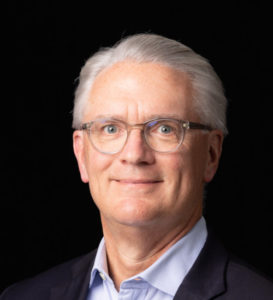 As the President of Quest Global, Bob is responsible for establishing and maintaining senior customer relationships, catalysing new business development, and overseeing innovative and transformational deals. In this role, he also assists in building relationships with strategic acquisitions for the company.